Interoperability, not isolation
Within IPCEI-CIS, Workstream 3, European partners have developed technologies covering different parts of the AI lifecycle: language-specific LLM, model repositories, federated learning frameworks for Cloud-Edge environments and MLOps platforms. Ambiti8n connects these technologies in one distributed environment and shows how they work together in practice. Rather than presenting each component separately, the project focuses on interoperability of ecosystem managed by different partners on the infrastructure located in multiple countries.
The project acts as a reference implementation for Workstream 3, while its architecture is also intended to fit into the broader 8ra ecosystem.
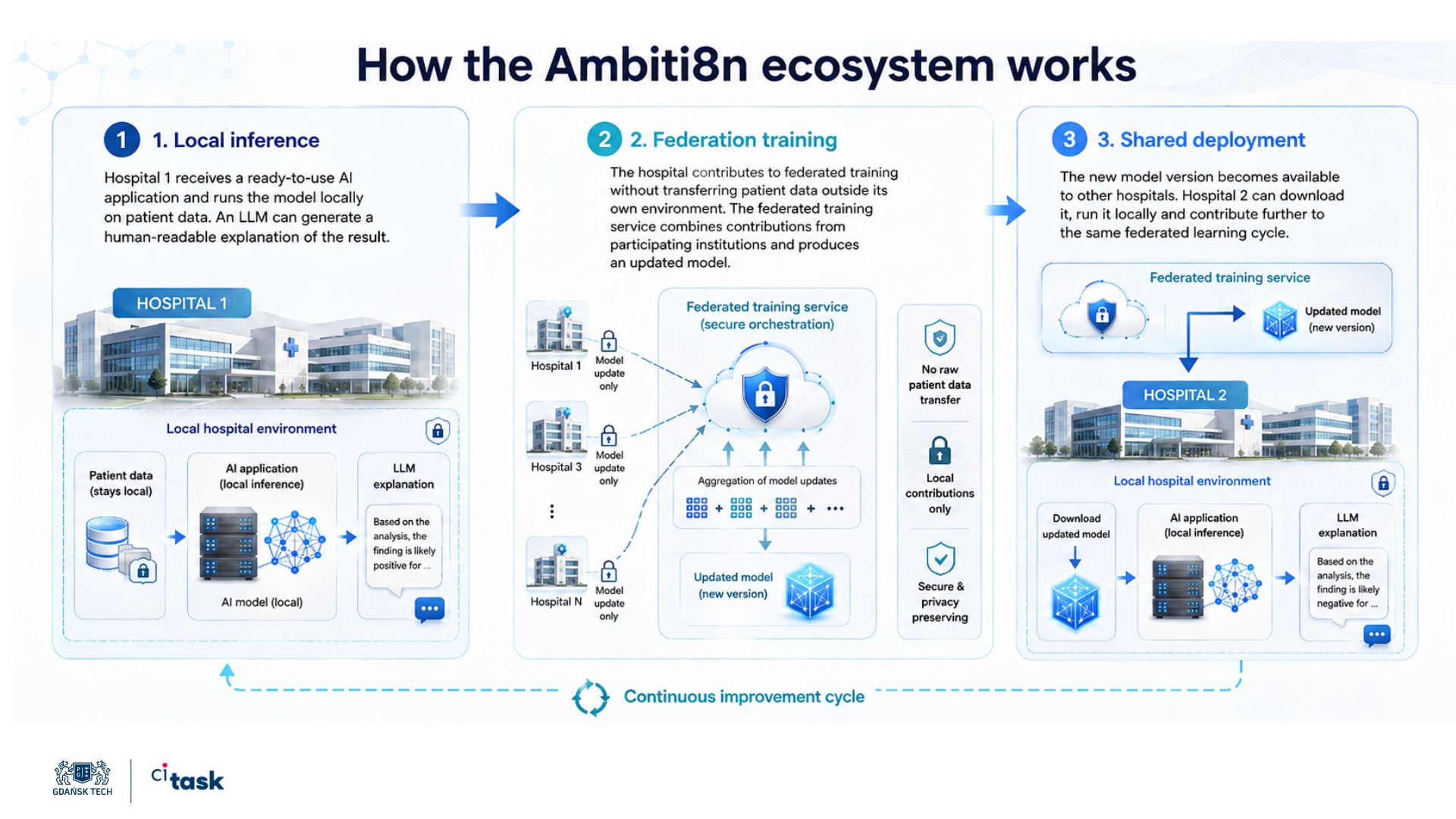
How the Ambiti8n ecosystem works
Now that we know the idea behind the Ambiti8n medical use case, we can take a closer look at how its components work together in practice.
- 1. Local inference — Hospital 1 receives a ready-to-use AI application and runs the model locally on patient data. An LLM can generate a human-readable explanation of the result.
- 2. Federated improvement — The hospital contributes to federated training without transferring patient data outside its own environment. The federated training service combines contributions from participating institutions and produces an updated model.
- 3. Shared deployment — The new model version becomes available to other hospitals. Hospital 2 can download it, run it locally and contribute further to the same federated learning cycle.
This allows institutions to contribute to a shared AI model without creating a central pool of clinical data.
A distributed cloud-edge architecture
The Ambiti8n ecosystem includes three main types of components: hospital environments, LLM providers and a federated training service.
Hospital-side services are typically deployed on-premises, close to medical data and within infrastructure subject to strict access controls. Federated training services and LLM providers can operate in public or private cloud environments, depending on technical and organisational requirements.
Distributed Cloud-Edge architecture in which workloads are placed in various infrastructures. Sensitive processing can remain close to the data, while more scalable services can be hosted elsewhere. The individual components are located in different countries and managed by different organisations while still communicating and operating as part of one federation.
Hospitals can also join or leave the federation without interrupting the work of other participants. This is an important part of the Cloud-Edge continuum concept: independently managed environments remain autonomous while still being able to cooperate when needed.
The role of CI TASK, Gdańsk University of Technology
A distributed AI system needs more than models. It also depends on computing resources, cloud services and reliable connectivity between environments operated by different organisations. This is where CI TASK contributes to Ambiti8n.
At Gdańsk University of Technology, the CI TASK (Centre of Informatics Tricity Academic Supercomputer and networK) operates the Kraken supercomputer and provides several computing services used for science and ind:
- HPC – hight-throughput infrastructure managed by Slurm;
- TASKcloud – an Infrastructure-as-a-Service cloud platform;
- CAISE – an AI training and management platform developed within the IPCEI-CIS initiative.
Within Ambiti8n, CI TASK provides infrastructure for the federated training service and for one of the hospital-side federated training clients. We are also responsible for establishing Cloud-Edge connectivity with partners operating hospital environments in several European countries.
— Krzysztof Drypczewski, CI TASK · Gdańsk University of Technology
Keeping clinical data local
Ambiti8n operates as a federated ecosystem in which components are deployed across clusters located in multiple geographical regions and managed by different organizations. Hospitals can join or leave the federation at any time without affecting the operation of other participants. This approach aligns with the Cloud-Edge continuum vision, which enables dynamic collaboration between cloud and edge environments.
Importantly, no clinical data ever leaves the hospital. Patient information remains within the healthcare institution, ensuring privacy, security, and regulatory compliance.
The reference implementation demonstrates how Cloud-Edge continuum technologies can be effectively leveraged to deliver low-latency processing within hospitals while providing scalability, resilience, and, most importantly for healthcare applications, data sovereignty and security by design.