The project: Ambiti8n
Ambiti8n is a federated AI platform built under IPCEI-CIS, the EU's cloud and edge infrastructure programme. Eight companies across four countries integrated their components into one working clinical application and demonstrated it live at the 8ra Annual Summit 2026 in Rotterdam — four months after the first line of code.
The problem the demo was built to solve is the one that stops most healthcare AI projects before they start: the data you need is the data you cannot move.
E-Group's two roles
E-Group came to Ambiti8n wearing two hats, and both mattered.
As co-lead of Workstream 3, E-Group was responsible for the horizontal reference implementation — the part of 8ra that has to prove the architecture works in practice, not only on a slide. That meant contributing to the IPCEI-CIS Reference Architecture (ICRA) v2.0 and then holding eight companies to it.
As an engineering partner, E-Group built two of the components the application depends on: FedX, the federated learning platform that trains the sleep apnea model across hospital sites, and the edge inference layer (KServe-based) that runs the trained model back at the hospital.
We are developing the sovereign AI stack for Europe — particularly federated sovereign AI blended with trust technologies, which is very important because of safety.
— Antal Kuthy, CEO, E-Group · Workstream 3 Lead
Why federated learning, and why here
The clinical use case is sleep apnea detection. A patient wears a consumer-grade sensor overnight; SpO₂ and heart rate are sampled every second; a CNN-LSTM model scores one-minute windows for apnea probability.
To be clinically useful, that model needs to learn from many patients across many sites. To be legal, it cannot see them. Two constraints sit on top of each other:
- GDPR — data minimisation is a legal obligation, not a design preference.
- GDPR Art. 9 plus hospital policy — hospitals will not export patient records to any third party, and that includes exporting them for AI model training.
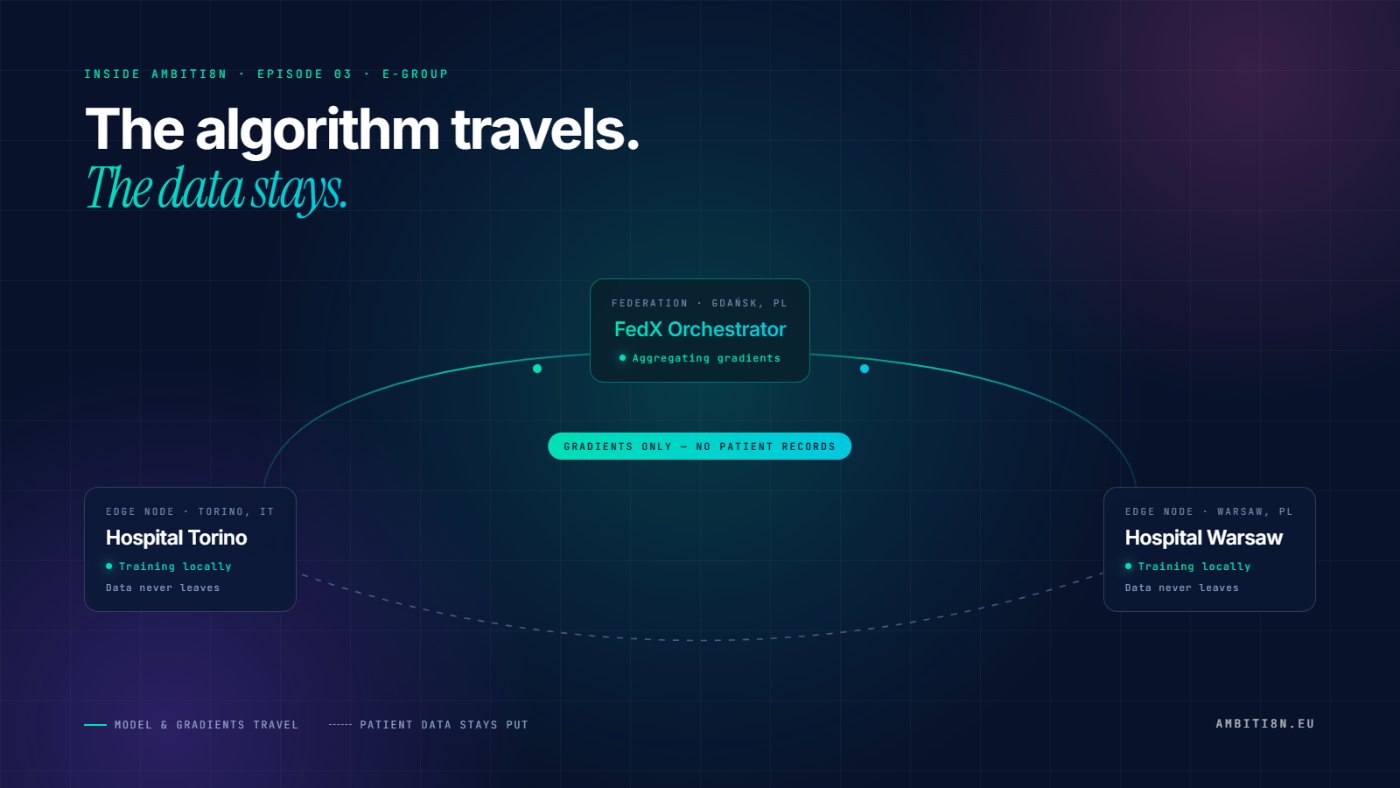
Federated learning inverts the usual arrangement. Instead of collecting data into a central training set, the model is sent out to each site, trains locally on data that never moves, and returns only what it learned.
Antal Kuthy's explanation on stage in Rotterdam was deliberately plain:
We have three hospitals. Data is local. Sensitive health data cannot leave the hospital. But at the same time we want strong models. This is where federated learning comes into play. The algorithm goes to the data, learns in each local node, and then federates the knowledge.
Or, as the team described it internally: the teacher visits each hospital privately, and only the notes travel back.
How FedX works in Ambiti8n
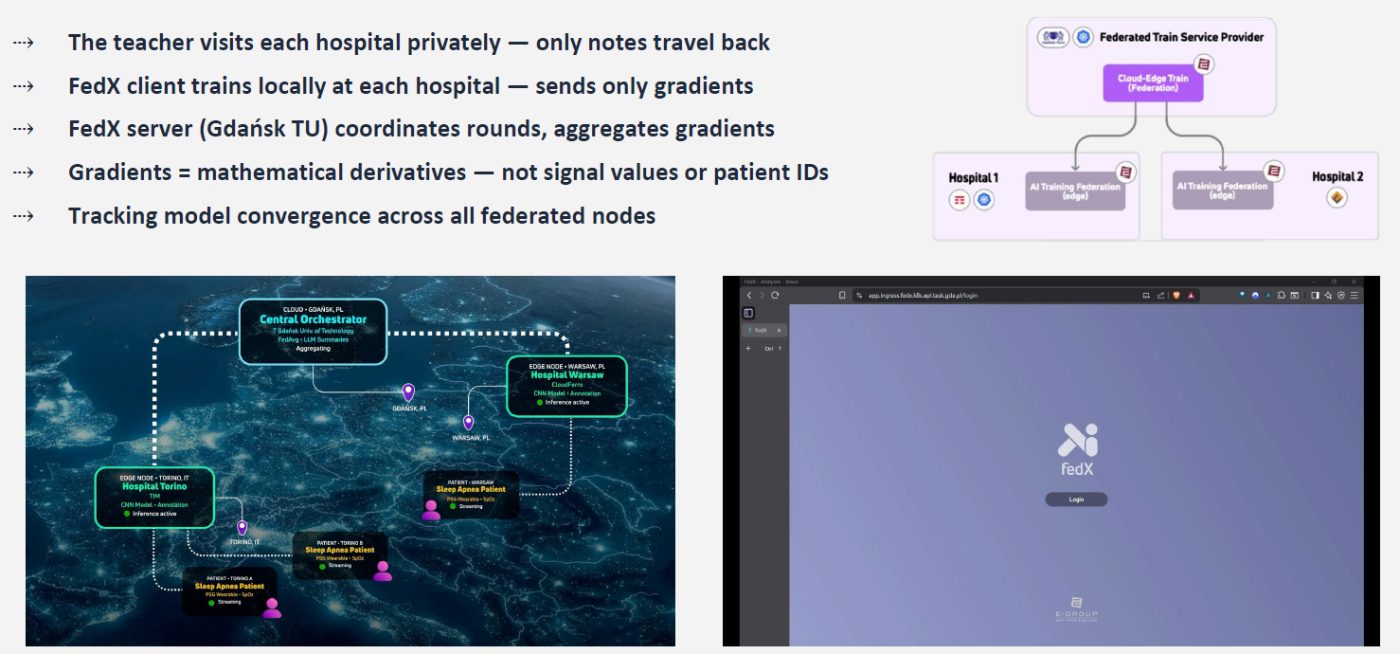
In the demonstrator, the federation spans hospital edge sites in Italy and Poland, with the training rounds coordinated centrally.
- FedX client at each hospital. Deployed at the hospital edge site, next to the local openEHR database and the data pipeline. It trains the CNN-LSTM model on local records only.
- Gradients, not records. What leaves the hospital is a set of mathematical derivatives — not signal values, not patient identifiers, not records. Nothing that can be read as a patient.
- Coordinated rounds. The FedX server side, working with Gdańsk Tech's Lab8ra platform and MLflow, aggregates the gradient updates from each node and issues the next round.
- Convergence tracking. Model quality is monitored across all federated nodes, so the team can see the shared model improving without ever seeing the data behind it.
The important architectural claim is not that federated learning exists — it is that it survived contact with four countries, three infrastructure providers, and eight partners' Kubernetes environments.
Bringing the model back to the bedside: edge inference
Training is only half the loop. A trained model that can only be queried through a public cloud API reintroduces exactly the problem federated learning solved.
So E-Group also built the FedX inference path at the edge:
- The CNN model is deployed on hospital infrastructure, at the edge site.
- No cloud round-trip, so latency stays low and the hospital keeps control.
- Every inference call is audit-logged locally — who, what, when, which component, for what purpose.
Ambiti8n runs two inference paths side by side, and the contrast is the point. The CNN runs at the edge, on hospital infrastructure, via E-Group's inference layer. The Villanova 2B language model that turns the CNN's output into a readable clinical report is too large for a typical hospital edge, so it runs on CloudFerro's Sherlock platform in a sovereign EU cloud region in Poland — as a project-specific instance, not a public API. Two deployment models, one application, both inside European jurisdiction.
Semantics had to hold across both. E-Group worked with Result to make openEHR plus the OMOP Common Data Model a mandatory data layer rather than a recommendation, because cross-partner data exchange fails quietly without a shared model — and eight partners in four countries is exactly where it fails.
Co-leading Workstream 3: the part that isn't code
Eight companies, four countries, no shared cloud platform, four months. On paper that is an integration problem. In practice, according to E-Group, it was a people problem first.
The most important thing is that you have to look at the people. People make things, not companies. It was a great journey to have these individuals who were excited and ambitious. So this is why we call this project Ambiti8n — because without ambition you cannot create anything.
— Antal Kuthy
The leadership approach he describes was deliberately individual rather than institutional:
My strategy was to keep this together at individual level, where everybody feels important and has a say and we can do something great together. That is how I kept this many companies, this many countries, aligned for a bigger goal.
Two technical decisions did the rest of the work. ICRA became the shared language — when eight companies name the same component the same way, integration conversations stop being translation exercises. And Helm plus Kubernetes became the universal integration layer, which is what made cloud-agnostic deployment across different providers' environments possible at all.
What was hard is worth stating honestly: partner maturity levels differed, process automation was limited, and every provider's Kubernetes environment had its own personality.
What this proves — and where it goes next
Villanova.ai's Altea EU AI Act compliance assessment (COD. 2635, verified 5 March 2026) rated it privacy-by-design positive, with strong data quality and traceability, and a verdict of intermediate maturity: technically coherent, governance-aware, valid as the WS3 integration demonstrator.
For E-Group, the direction from here is horizontal. Federated learning is not a healthcare technique that happens to work elsewhere; healthcare was simply the hardest place to prove it.
We see that it is more and more recognised that you need to be data first if you like to be AI first. Data is essential, but data is distributed — especially here in Europe. Luckily, industry data is still with the industry, 80% of it. So we need new technologies where we can enforce that the data stays, but we can still learn from it.
— Antal Kuthy
The direction for Ambiti8n is that it goes from health to agriculture, to energy, to manufacturing — all very important sectors for Europe, even tourism — where the AI processing layer built together with all eight companies can flourish.
The FedX platform already spans five verticals: healthcare, automotive, cloud-edge services, federated language models and agentic AI coordination. The next steps for the demonstrator are production hardening, more AI models, wider federation and a clinician feedback loop — with FedEU.ai, positioned in the CISERO exploitation roadmap, as the route from demonstrator to service. The target is a ready-to-scale validation decision by the end of 2026.
Behind the scenes: federated AI, Kubernetes clusters across four countries, and strict EU-compliant data controls. In the clinic: a clean view of patient signals, and decisions that stay in the doctor's hands.
The complexity is real. The simplicity is the achievement.
— Antal Kuthy, CEO, E-Group · Workstream 3 Lead
E-Group's components in Ambiti8n
| Component | What it does |
|---|---|
| FedX federated learning | Trains the CNN-LSTM apnea model locally at each hospital; only gradients leave the site |
| FedX edge inference (KServe) | Runs the trained model on hospital infrastructure — low latency, locally audit-logged |
| openEHR + OMOP data layer | Shared semantics across all eight partners (with Result) |
| WS3 co-lead + ICRA v2.0 | Architecture governance and consortium alignment |